Showing posts with label Pets. Show all posts

Friday, 26 July 2013

The Otters this Summer


Sophie Neville ~ otters
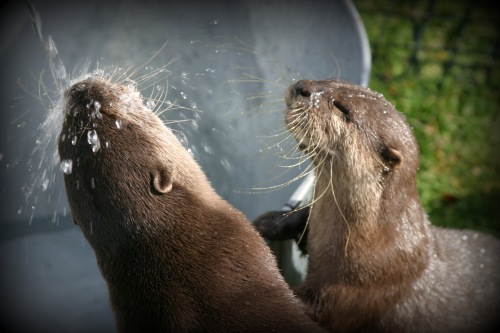
Our tame otters, who romp through the pages of Funnily Enough, are still going strong. The have a huge number of fans including Her Majesty the Queen, HRH The Prince of Wales, Sir David Attenbrough, Joanna Lumley, David Bellamy, Angela Ripon, Michael Meacher MP and Michael Fish the weather man.


In 2013 they appeared on ‘Wild’ on CBBC
at the CLA Game Fair and Royal Welsh Show and in the Sunday Telegraph. 
They also enjoyed meeting people in Devon at the Honiton Show,
at Frampton-on-Severn in Gloucestershire and The Romsey Show in Hampshire. 
click here for their diary ~


Saturday, 29 June 2013

Mum, Dad and their tame otters

Daphne Neville with Rudi and Martin Neville with Belinda - their tame otters

My parents have kept tame otters since about 1980.
Over the years they have collected quite a few stories about them.


They are very inquisitive,


love eggs


and playing in the hay.


but most of all, they love being loved.

They appeared on CBBC TV in 'Wild' one Saturday morning recently
and will be at the Royal Welsh Show all this week 

These beautiful photographs were taken recently for a feature in the Sunday Telegraph

Please click here for the article published on 21st July 2013 


Thursday, 23 May 2013

Filming our tame otters

Daphne Neville

Filming with otters is never easy. You can imagine what happened 0.05 seconds after this photograph was taken. On the other hand, our tame otters will spend ages drying off after a swim.

Daphne Neville


The easiest way to photograph our Asian short-clawed otters is when they are elevated in some way. Rudi is good at climbing but will descend with caution as he is not built to jump.

Often the script calls for an otter to be swimming underwater. Whilst this is possible it takes a long time to capture a sequence. A whole day was needed to take one underwater photograph for the scene in The Waterbabies. Here the little boy playing Tom is letting a young otter smell his hand. 

Setting up a shoot with one of the otters for 'The Waterbabies'

Much depends on the confidence of the actors appearing with the animals. Whilst Belinda is completely relaxed in my father's arms, she remains a wild creature and it takes her time to get used to strangers.

Martin Neville with Belinda the Otter ~ photo: Daphne Neville

This little girl who appeared in the drama series 'The Secret of Eel Island' was wonderful with the otters.

Photo Daphne Neville


Many of the scenes were set on a houseboat which worked well as they could not jump off it and there was no chance for them to off run into the woods.

Belinda the Otter in 'The Secret of Eel Island': photo ~ Daphne Neville

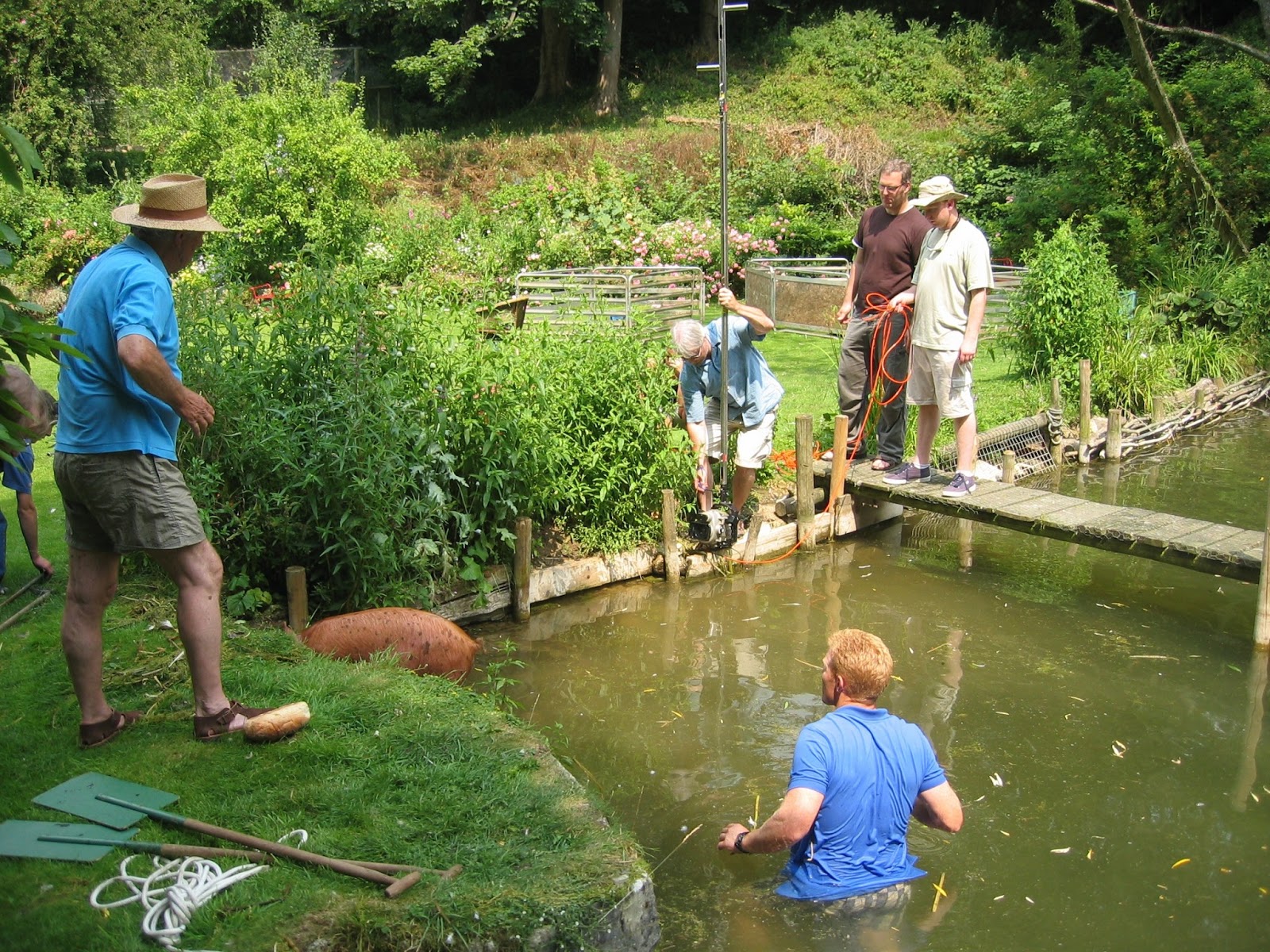
Oddly our otters don't like swimming in our lake. I think Adam Henson must have lost one here.

Adam Henson filming in the otter's lake

No, he was after a pig.

Adam Henson filming in the otter's lake

At least you can carry an otter about and hold one in your arms.

Sophie Neville

To read more ~ click here

Friday, 17 May 2013

More about our tame otters who appear in 'Funnily Enough'

Sophie Neville tame otters

We still keep two tame otters at home in the Cotswolds. Bee and Jims who appear in 'Funnily Enough' passed on some time ago but Belinda and Rudi are just as delightful. Belinda is the tamest otter we have ever kept. Here she is, sitting on Mum's shoulder.

Belinda the Otter

Rudi is exceptionally energetic, a real climber.


Belinda is now fourteen, which is a great age for an otter. Their life expectancy in the wild is only about eight years at the maximum.


They are in good condition and eating very well - on a diet consisting of raw trout, day-old chicks and rare beef - but as a result must be the fattest otters you have ever seen.


Sunday, 10 March 2013

Influence through Art ~


Phylo-sophy illustrated by Caroline Assheton

Tell someone you love them

The best way to keep warm


Invite your friends to something special

please
click here for
~ Greetings cards by Caroline Assheton ~

or leave a comment below

Friday, 14 December 2012

My mother and her otters

Daphne Neville with her tame otter Bee
Daphne Neville
who has been working in otter conservation from 1981


In 1981 we learnt from a survey conducted by English Nature that there was a disastrous decline in the native population of otters in England and Wales. It was estimated that there were only 80 pairs left whilst Scotland was maintaining about 6,000 otters.  

My mother took it upon herself to raise public awareness of our aquatic eco-systems. Over the years she has been asked to hand rear a number of zoo-breed Asian short-clawed otters who have delighted the public whilst acting as ambassadors for their species. Thousands of adults and children have met the otters and learnt how the public can help encourage the revival of our native species - often about a topic they have not considered before.

Daphne Neville's tame otter Bee
Our first tame otter ~ called Bee, as otters smell of honey


It's clear that England and Wales were about to lose their native otters when Mum began working.  This major British mammal species is now reviving thanks to recognition that we need pure river water and undisturbed river banks. My parents advise farmers on how to accommodate wild otters and encourage the public to pick up litter, control their dogs, and drive slowly along lanes at night to reduce road casualties. They have been able to convey the difficult concept of water quality by taking otters to occasions such as the Water UK conference and The Otter Forum at the Natural History Museum.  The decline of otters in England and Wales related entirely to pollution: the discharge of industrial waste such as chemicals used in the manufacture of carpets entering the River Severn, farming effluent from slurry pits and slippage pits, sheep dip and indiscriminate use of PCBs and DDT insecticides. Otters are a vital indicator species, their health directly reflecting the health of British rivers.

Daphne Neville with her tame otter Bee
Daphne Neville with Bee the Otter

The work is physically demanding – it requires travelling long distances, working long hours in all weathers, getting soaking wet, then camping on site - but Mum always finds the energy to give a child her full attention, even when totally exhausted at the end of a long day.

The rewards? One man told her that he had just completed a zoology degree, having been inspired by a talk she gave at his primary school years ago. That was enough. She has done much to educate inner-city adults and children who know nothing about otters. When she appeared at Countryside Live, on the Olympic site at Hackney Marshes in North London, I heard people look at an otter and ask, ‘Is it a squirrel?’, ‘Is it a rat?’ and ‘Does it eat vegetables?’

My drawings of our tame otters can be seen here.
with further sketches on this page.

Monday, 9 July 2012

Parrots I have known ~


'Funnily Enough' by Sophie Neville available in paperback from Amazon


Today I have been writing about parrots. Parrots I have known. Parrots I have lived with. Parrots I've observed in the wild. I've even appeared in a movie with a parrot on my shoulder. And on television.  In front of the camera not once but twice!  Am I brave or what?

When I was little my grandmother kept two budgerigars. They were called Pippernella and Chrysanthemum. Pippanella was blue, Chrysanthemum was green and yellow. Everything about them entranced me. If we were good and very gentle we were allowed to take them out before bedtime. Since Granny was an invalid, stuck in the house all day long, the birds had become her very special friends. They were beautifully cared for. If one of them shed a tail feather it was kept in a glass vase on her desk.

My parents must have kept parrots, parakeets or macaws for most of their married lives. We were given two of them. They out-lived their original owners and were brought to our house. I've no idea why. It is amazing that they stayed. My mother couldn't bare the thought of them being cooped up in a cage so let them out as much as possible. They loved this but it caused endless dramas. Josey-Jo, my mother's Blue-fronted Amazon parrot would fly around the house only to lose sight of places to perch. If you weren't careful she'd land on the top of your head. It can give a girl quite a fright. Once she landed on the side of a frying pan, once she ended up in the dish-washer. Dad nearly turned it on with her inside. She did terrible damage too, nibbling away at the top of veneered corner cupboards or antique picture frames, dining room chairs and rather a good chest of drawers.

We thought that an aviary would be the answer. The result was an enormous parrot cage built outside the kitchen door. This is illustrated above. Please don't copy the design. It did not work well. For some reason it now houses guinea pigs.

Josey-Jo was eventually given quite a large cage in the dining room where she happily spent her days. She originally belonged to an old lady and had picked up her voice. When you arrived home she would say, 'Hellow' in a slightly cracked and rather smart inquiring manner, sounding exactly like an 87-year-old woman. Any stranger would ask if Granny was still at home. No burglar alarm could work better.

Henry, our scarlet macaw, had a perch rather than a cage. He was unable to fly but loved being allowed to sit in the willow tree or on a post in the garden where he could see everyone come and go. Sometimes he would climb down and alarm visitors by walking pigeon-toed across the lawn to greet them, bent forward so that his tail did not touch the grass. His long red tail feathers were kept in a jug too.

When I lived in Africa I often came across small Meyer's parrots in the wild. Apparently they are often considered 'parrotlets'. No matter. They gave us such joy. One sighting and one's spirits would soar. Apparently they are classified as 'trans-continental parrots', having the widest distribution of any parrot in Africa. You can find them from South Africa up to Ethiopia, flashing through the trees.

The filming? Ahh, you can read about filming with Captain Flint's parrot and appearing on Animal Magic on my other blog. The most bizarre experience - which I don't think anyone has ever written about - was when I went with Alastair Fothergill to watch the wildlife camera man Simon King filming great tits in Bristol. They were about to fledge from a bird box nailed to someone's shed in rather a grotty part of town. The only way of reaching the long back garden was through a basement flat belonging to an odd old couple who were living in an extreme state of squallor and filth, almost like tramps. They had a budgie. It seemed very happy and was singing away but obviously hadn't been cleaned out for years, so many years that a column of black and white flecked guano had formed on the base of the tiny cage, rising nearly five inches high towards the perch on which the little bird sang. I didn't know what to say. We walked on to relieve Simon. This was crucial. He hadn't been able to leave his camera position all day for fear of missing the moment when the little great tit chicks left the nest. As a result he was dying to go to the loo. I told him that he'd better let Alastair take over for a while or he'd end up like the budgie.